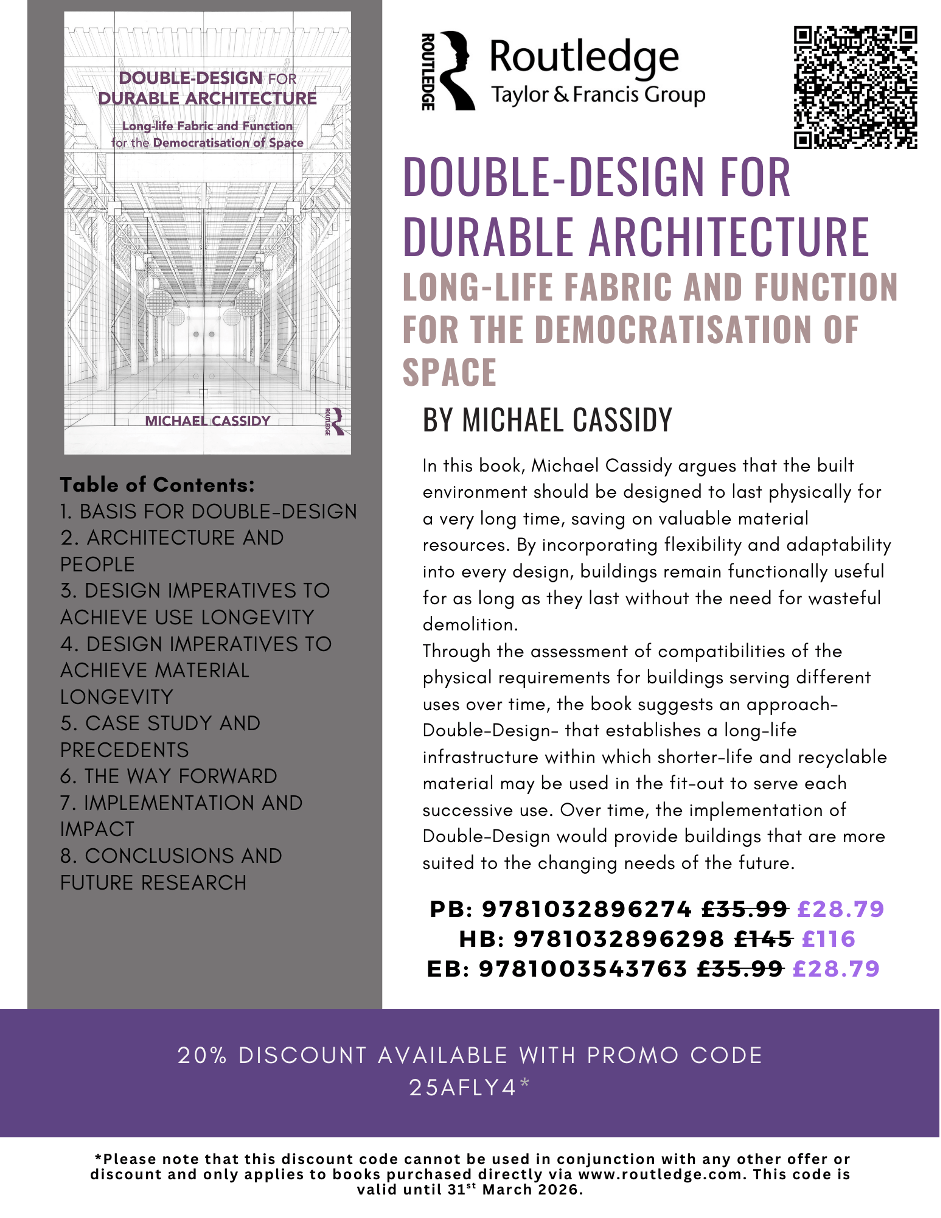
The Book
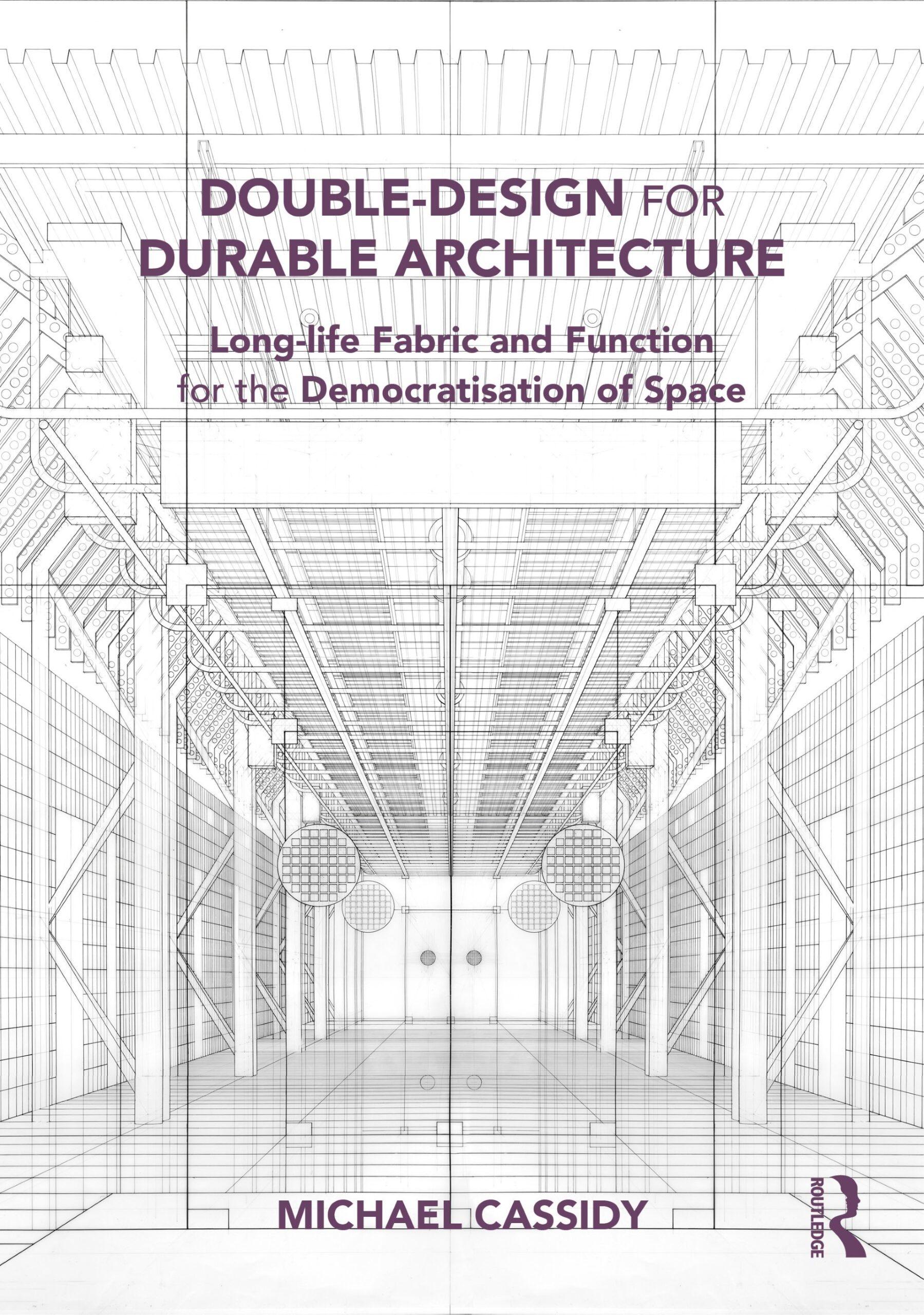
In this book, Michael Cassidy argues that the built environment should be designed to last physically for a very long time, saving on valuable material resources. By incorporating flexibility and adaptability into every design, buildings remain functionally useful for as long as they last without the need for wasteful demolition. This approach, which he calls Double-Design, has two complementary consequences. Firstly, design must accommodate changing uses beyond the initial one. Secondly, the users of buildings would be enabled to play their full part in ensuring the usefulness of buildings for as long as they last physically.
The book suggests an approach that establishes a long-life infrastructure within which shorter-life and recyclable material may be used in the fit-out to serve each successive use. Over time, the implementation of Double-Design would provide buildings that are more suited to the changing needs of the future.
Guided by sixty years of professional experience, Dr Cassidy considers the underlying assumptions that provide the present context for design and construction.
This is essential reading for practising architects, those entering the profession, and anyone interested in the built environment’s future. The book is considered an important contribution to the debate about the future of architecture in the new era of information.
“Double-Design is a visionary concept that has the potential to redefine architecture for a sustainable future; it addresses key challenges of resource efficiency, waste reduction, and uncertainty. Double-Design offers a pathway to reconcile tradition with innovation. It is a call to architects to embrace their role not just as creators of buildings, but as stewards of a built environment that serves both present and future generations”
Axel Ilhuicamina, Architect, Mexico
“Music to the ear in a world that is stridently discordant. A few thousand years ago humans took shelter in caves to protect themselves from changes in the environment. As the species succeeded, accommodation was expanded by excavating additional spaces; simple and effective with little environmental impact. Numbers have caused us now to operate in the built environment but we would be well advised to retain the same principles where shelter is more or less permanent and can be adapted to fulfil changing roles and requirements. Double-Design […] will make sufficient differences to the environment to make the future desirable again.”
Richard A D’Arcy, Architect and CAD Pioneer
“I see Double Design as one of several strategies that could lead to more responsive and inclusive environments. With Universal Design pointing towards ergonomics, inclusivity and personalisation, and Sustainable Design addressing the energy (operational and embodied) consumption – I have a sense that Double-Design – is a wider overarching framework – about ‘place-making over time’ giving the environment – and its fabric – time to breathe over a couple of generations.”
Rod Bond, Architect and IT Researcher, Ireland, UK
“[This] book is a great place for clarification and understanding many frustrations, confusions and complexities faced by students and architects at different career stages. Longitudinally, buildings last and should last for a long time. So do and should our architectural career and our education.”
Quinsan Ciao, Professor of Architecture, China
Preface The Book
In 2017, Michael Cassidy was exploring options to pass on some of his experience from a lifetime in architectural practice to the younger generations. Walking into university with a notion to possibly do some lecturing, he came out with a completely different project: that of bundling this experience into a PhD thesis.
In an unusual reversal of the typical situation, Pieter found himself with a new doctoral student many years his senior. The supervisory process that followed was also highly unusual. Rather than having to drive forward research and data collection, here the challenge was to ensure the strong focus needed for a doctoral thesis and to keep interesting side paths and connected topics firmly positioned in the appendices and “further work” categories. The topic and approach ended up being ambitious and unconventional, applying grounded theory to extract themes from a 50-year career and narrowing the scope of the work to a topic that touches a fundamental issue related to sustainability in the built environment, which is space use longevity.
By the time Michael had completed his thesis, Pieter had the interesting challenge of finding an external examiner for a work that deals with a rather unusual topic that blends building performance, design and building longevity. Enter Clarice, with her experience in decision making for regenerative design, sustainability and performance. The resulting PhD-viva was a “mind-meld” across generations. The presentation was unconventional, particularly strong in problem definition and exploration of ideas, as well as theoretically robust, whilst populated with thoughtful discussions on Michael’s past design work across different countries.
Michael went back to the work of the 60s, 70s and 80s when critical thinking was an integral part of research and meaning was more important than data; qualities that were lost in the digital age, in which information overflow and AI seem to replace human thinking without necessarily solving any of our fundamental problems. Having AI and ‘data pollution’ out of the discussion, Michael suggests space use longevity should be parameterised and provides routes for implementation, together with open gaps to be addressed by further research.
Problem definition highlighted that despite the multiple studies on individual aspects of interactions between users and buildings, there is still no practical guidance on how to Double-Design. Michael’s PhD and whole career work, therefore, presents a comprehensive economic and environmental contextualisation for change of use in buildings, with an in-depth problem definition followed by a pragmatic methodology pushing for parameterisation as a way to respond and cope with uncertainties.
The book “Double-Design for Durable Architecture” that you have in your hands is a strongly extended version of Michael’s PhD thesis. It can be seen as a manifesto about the role of Double-Design in sustainability.
Too often, we simplify building sustainability to a simple analysis of predicted energy use or predicted greenhouse gas emissions, which under the paradigm of the Circular Economy should be easily disassembled to be reassembled to meet future uses. Yet truly sustainable buildings need to reflect much deeper design efforts; they need to be made to last beyond their users’ and stakeholders’ lives. Longstanding buildings require architects to become ‘enablers’, balancing between the needs of building users and other stakeholders with the possible multiple uses buildings will have throughout their lives. They also require a shift in the role of building users and building owners to ‘building custodians’ responsible, together with designers, for (in Michael’s words) ‘the ongoing optimisation of space-use over time’. This idea contradicts the notion of user-centric customisation. Double-Design pushes the boundaries of our environmental goals, looking into societal needs and the wider political context of living within planetary boundaries.
“Double-Design for Durable Architecture” forces us to take a hard look at the life span of the buildings we design and construct, and how to make the best use of the resources we invest in. It aligns well with the emerging interest in the topic of flexible and adaptable buildings, built to accommodate uncertainties that span from changes in use to changes in environmental conditions, minimising demolition, reconstruction and, as a consequence, reducing environmental impact.
The book is a call to action for the domain of architecture to take control of the direction of the field and narrative, and to double down on efforts to create buildings that are fit for purpose for a long time to come. Encouraged by the publisher Routledge, the book explores some of the “future work” that was pruned from the original PhD thesis, providing a rich account and background to the thesis that architecture needs to engage in Double-Design.
Beyond the Ph.D. thesis, this book represents an incredible integration across space and time. Michael’s studies span over half a century of development, and for us as “young” academics, it has been fascinating to work with someone who has met in person with some of the intellectual giants of the past. Michael brings a geographically and culturally rich experience to the subject that has been gained across continents. These deep roots provide a firm grounding for a theory that reaches far into the future.
Prof. Pieter de Wilde
Lund University /LTH, Lund, Sweden
Prof. Clarice Bleil de Souza
Cardiff University, Cardiff, United Kingdom and Université Catholique de Louvain, Louvain-la-Neuve, Belgium.